
Google CEO Sundar Pichai is now also the CEO of Alphabet.
FEATUREDBUSINESSTECHNOLOGY
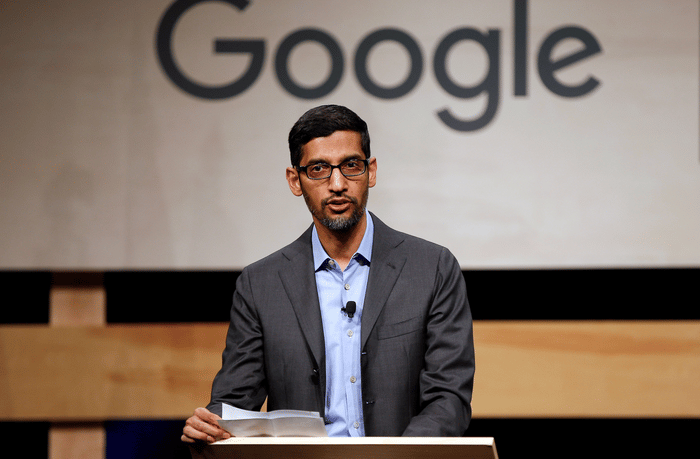
The End of an Era: Sundar Pichai Takes Full Control as CEO of Google and Alphabet.
SAN FRANCISCO— In a monumental shift that fundamentally reshaped the leadership of one of the world’s most powerful companies, Google CEO Sundar Pichai was appointed the chief executive officer of its parent company, Alphabet Inc., consolidating the leadership of the entire tech empire under one executive.
The move, which occurred in December 2019, marked the definitive stepping down of Google co-founders Larry Page and Sergey Brin from their active executive roles, formally concluding their two decades of day-to-day management of the search giant and its sprawling subsidiaries.
While the news is several years old, it remains a critical turning point in Silicon Valley history, cementing Pichai’s role as the sole operational commander of a conglomerate that controls the world’s information, cloud infrastructure, and “moonshot” projects.
The Founders’ Final Exit
The transition was announced in a joint blog post by Larry Page, who was previously Alphabet’s CEO, and Sergey Brin, who served as its President. They stated that the time was right for the company to "simplify its management structure" and that Alphabet no longer required two CEOs and a President.
Page and Brin positioned the move as a sign of maturity, noting:
"Today, in 2019, if the company was a person, it would be a young adult of 21 and it would be time to leave the roost."
While the founders officially stepped back from executive duties, they retained their board seats and, crucially, maintained their controlling shareholder status through their ownership of super-voting stock. This means they continue to hold ultimate power over the company's direction, but they fully entrusted the execution of that vision to Pichai.
The Scope of the Dual Role
Pichai's new responsibilities are immense. By taking the helm of Alphabet, he gained command over two distinct yet interrelated parts of the organization:
Google (The Core): The search engine, Android, Chrome, YouTube, Google Cloud, and all core advertising and services—the primary engine of Alphabet’s profit.
The Other Bets (The Future): This portfolio of ambitious, often experimental projects includes self-driving car company Waymo, drone delivery service Wing, life sciences group Verily, and the innovation laboratory X Development. These “bets” were the original motivation for forming Alphabet in 2015, intended to separate the speculative projects from Google's core business.
The consolidation under Pichai meant that for the first time since the 2015 restructuring, the profit engine and the moonshot projects were being overseen by a single chief executive.
Pichai’s Rise: The Operational Leader
Pichai’s ascent was not a surprise. He had been a rising star at Google since joining the company in 2004. He led the development of successful products like Google Chrome and Chrome OS, and later took control of Android. When Alphabet was created in 2015, he was named CEO of the core Google business, proving himself to be a highly effective operational leader.
Unlike the often-combative internal culture that preceded him, Pichai earned a reputation as "The Great Compromiser." His management style is known for being collaborative and focused on consensus, a quality that helped him navigate the complex landscape of Google’s vast product offerings and global operations. His successful management of Google’s massive growth—doubling its headcount and significantly increasing its revenue—made him the natural successor to lead the entire organization.
The Political and Regulatory Burden
The timing of the 2019 transition was highly significant, occurring as Alphabet faced an intensifying wave of regulatory and political challenges worldwide.
Larry Page and Sergey Brin had become increasingly private and absent from public-facing corporate events, including congressional hearings and weekly employee Q&A sessions. By stepping aside, they effectively passed the burden of navigating this political firestorm—including employee unrest, antitrust investigations in the U.S. and Europe, and government scrutiny—onto Pichai.
This shift confirmed Pichai as the company’s face to the world, tasked not only with innovation but with managing the public perception and legal defense of a company now frequently labeled a monopoly.
A Legacy Confirmed
Sundar Pichai’s appointment as CEO of Alphabet was more than a mere management reshuffle; it was a defining moment that transitioned the company from the founder-led vision of Page and Brin to the operational reality of the modern, heavily scrutinized tech conglomerate.
The move finalized the end of the founding era, ushering in a new age where a singular focus on execution, disciplined capital allocation across the "Other Bets," and navigating the complex currents of global artificial intelligence and regulation became the primary mandate for Alphabet's top executive.